Sunday, April 15, 2012

Faniticism

Head-on deliberate midair collision is a weapon of heroes. Glory to the Stalin's falcons, threat to the fascist predators!
When I created an entry for propaganda I had found this fascinating image that I believe says a lot about the type of army that Stalin was trying to build. It seems as though he was constructing an army that was closely related to the Japanese of WWII. The Japanese are well known for the Kamikazes, which is the exact strategy that is being advocated above. The reason that the Japanese willingly did this was that they believed they were bringing glory to their homeland, which is exactly what I believe Stalin wanted. However, the Japanese had constructed the concept of self sacrifice through tradition, dating all the way back to the days of the samurai. Stalin however, was forcing this ideology that was relatively nonexistent through Russian history. So, the question that must be asked is why would the Soviet people adopt this concept?

I believe the to answer this question is that they did not willingly adopt this concept, but were forced to with such orders as order 227, which I discussed in an earlier post. But, why did they not turn on Stalin when in many cases they were forced to march to their death in a fashion with an outcome similar to a banzai charge? I believe the people feared Stalin's power to such an extent that they were unwilling to go against him. If they failed to usurp his power they would have surely been killed, but if they had begun to organize there was a strong chance the NKVD would have discovered them and subjected them to similar circumstances as the trials that either killed or banished anyone that was suspected of conspiring against Stalin. I believe Stalin was able to create a fanatical army like the Japanese not through tradition like them, but through pure fear of the power that Stalin was capable of unleashing.

Bibliography

Russian WWII Propaganda Posters. n.d. http://www.allworldwars.com/Russian%20WWII%20Propaganda%20Posters.html (accessed April 15, 2012).

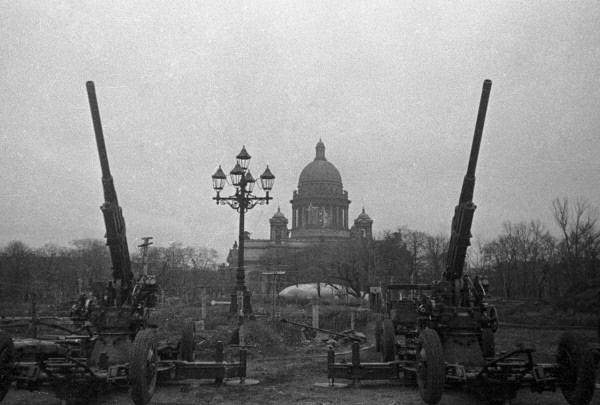
Leningrad

In September 1941 the city of Leningrad had fallen victim to a siege that would continue until January 1944. The Germans goal was to terrorize and starve the population into submission, which was accomplished through cutting off all railway access to the city and bombarding the city itself. Eventually the only path that was left was the frozen lake Ladoga, which became known as the "Road of Life." However, this route was incredibly difficult to cross; many of the convoys that attempted to cross fell through the ice, while others fell victim to strafing runs from the Luftwaffe. The efforts of the Germans to force the city into submission was successful and as one citizen recorded in their diary "We have returned to prehistoric times: life has been reduced to one thing -- the hunt for food."

As the Winter set in, fuel supplies became scarce and just to stay alive the citizens chopped down trees and break down wooden houses for heating. Also, as stated on the website Seventeen Moments in Soviet History "People ate anything to stay alive -- rats, mice, cats, dogs, birds, bark, tooth powder, glue, and (in how many instances can never be known) human flesh." When people succumbed to death they were simply left in the streets and because of the massive amount of deaths it can be assumed that many were not collected for burial when they were initially placed in the street. In January 1944 the Siege was lifted with a staggering 800,000 dieing from starvation, and another 200,000 dieing in both the defense of the city and bombardments.

This was truly a traumatic event for Russia during the Nazi invasion, but the story of Leningrad could help the war effort. The citizens of Leningrad were forced to face grueling and Hellish conditions for roughly 900 days, but the city survived. Although many people were lost the city refused to fall and approximately 600,000 still lived. I believe the Soviets viewed this event as a point of the war that they could turn to when things looked bleak to believe that they would survive no matter what the Nazis threw at them. The siege of Leningrad was an incredibly horrific event, but it can be seen as a rallying point for nationalism during the war.


Bibliography

Geldern, James von. Seventeen Moments in Soviet History. 2012. http://www.soviethistory.org/index.php?page=subject&SubjectID=1943leningrad&Year=1943 (accessed April 15, 2012).

Friday, April 13, 2012

The Battle of Kursk

The battle of Kursk was one of the largest tank battles in history with hundreds of tanks participating on either side. The battle had begun when the Soviets had captured a group of Nazi engineers who were sweeping for mines and received confirmation of the German advance. The engagement was scheduled for the following day, so the Soviets used the element of surprise to their favor by unleashing an artillery bombardment on the suspected German positions. However, the Soviets simply disrupted artillery an observations with the initial barrage because of their lack of intelligence on the enemies actual positions. This surprise attack then forced the Germans to begin their advance prematurely and engage the Soviets.

Over the following days the German attempted to push through the Soviet defensive line, but only gained a few miles by the second day. During this time the Soviets fought with an extreme passion, attempting to use any means possible to prevent the German advance. In one case the Soviets are said to have "even brought their 45mm guns (which were ineffective against the Tiger's armor) into action to fire at the tracks of the Tigers, in an effort to immobilize them." Many may see this as pure stupidity on the part of the Soviets but I view it as an act of extreme dedication to Russia because they used any means available to attempt to weaken the Germans.

After a few days of the German advance the battle reached its most intense moments. On July 12 the Germans were pushing forward with a force of about 600 tanks, 100 of which were Tigers. This was all that remained of the Germans initial force. The Soviets were standing ready with 850 tanks and self propelled guns waiting to receive the German forces. Before these forces met the Soviets began a brief artillery bombardment to weaken the advancing forces, but the Germans responded with their own artillery, heavy tanks, and airstrikes. In the moments that followed the Soviet front-lines of tanks were advancing so fast that they went straight through the German forces. This forced the tanks to fire at point blank ranges, which was one of the weaknesses of the Tiger tank because it was easier to punch through their front and side armor at close ranges. As hundreds of tanks poured onto the field the battle raged on and as Major Enrique Ramos pointed out in his thesis "the battlefield was a heap of broken and burning steel, machines, and human bodies." Shortly after the battle Hitler withdrew all forces to reposition troops for the Allied invasion of Sicily. Regardless of the reason for the German retreat, the Soviets inflicted massive casualties and won the battle.

The battle of Kursk was a major victory for the Soviets because even-though the Germans had better tanks, the Soviets still succeeded. Also, the Russians had brilliantly executed a strategy of close quarter attacks to destroy the enemies heavy tanks. This can also be attributed to the Soviets having significantly more tanks in the battle, but it was still a great achievement for the Soviet morale. The might of the Soviets tanks had been proven. By defeating an advance that included some of the most powerful tanks in the war, the Soviets knew that they had the superior force and would achieve victory.

(The main pages of interest with the link to the PDF are pages 75-83)

Bibliography


Ramos, Enrique, MAJ. “Analysis and Significance of the Battle of Kursk in July 1943.” Master’s thesis, 1995. Defense Technical Information Center. Accessed April 13, 2012. http://www.dtic.mil/‌cgi-bin/‌GetTRDoc?AD=ADA299270.

Sunday, April 8, 2012

Propaganda

To fully understand WWII it is important to analyze the home-front as well as military engagements. One of the best ways to get a glimpse into this aspect is reviewing the propaganda that was presented to ordinary citizens. Also, by viewing these images one can gain an understanding of the military strategy that was pursued by the government to attempt to win the war.

Cut the enemy!
The first image is very interesting because it is presenting a soldier that is using a sword and a horse to defeat his enemy. During WWII both swords and horses had become obsolete in military engagements throughout the World because they were replaced by guns, cars, tanks, etc... However, if one truly ponders the meaning of this image they will gain an understanding of the Soviets in the war. The Soviets did not have a proper supply of munitions and this image shows that they were utilizing the resources that they had, regardless of the chances for success. With this in mind it is hard to imagine charging semi-automatic weapons with a horse, but it is understandable that the Russians needed to use anything they had in order to present a significant opposition.
Our forces are uncountable 
This image is rather interesting because it presents one of the primary strategies the Soviets used during the war, which was to utilize people as the primary resource for the war effort. This presents the same concept as the first image, which is the military utilizing the resources that they had. There were not enough munitions to go around, but what Russia had plenty of was human resources. It did not matter how many people would die, it only mattered that they could crush all opposition through simply having a larger force. This idea of people as an expendable resource may seem disturbing to some, but it was necessary for the success of the Russians in the war.
If you are surrounded, fight till the last drop of your blood
This image presents an idea that may seem counterproductive to the war effort by presenting a soldier who will die in the war. However, by ordering soldiers to take as many Nazis with them before they die a nationalistic feeling is created. This image presents the idea that it did not matter if a soldier died in the war, so long as they died as a hero defending Russia. Even though this image presents soldiers as heroes, it still seems peculiar to remind soldiers that they probably wont be returning from the battlefield.

All of these images truly demonstrate how Russia planed to win the war, which was to use a vast supply of people to destroy the German forces. It is hard to imagine people willingly going to battle under these conditions, but if a government appeals to a citizens love for their country almost anything is possible.

Bibliography

Russian WWII Propaganda Posters. n.d. http://www.allworldwars.com/Russian%20WWII%20Propaganda%20Posters.html (accessed April 8, 2012).

Wednesday, April 4, 2012

The Battle of Stalingrad

Stalingrad before the war
Ever since the beginning of Russia's involvement in WWII Stalingrad had gained significant importance. Stalingrad had become one of Russia's largest arsenals of the war and was tasked with the production and maintenance of tanks, artillery, mortars,sub-machine guns, and various other military supplies. It was for this reason that Stalingrad had gained strategic significance during the war. The Wehrmacht believed that the capture of Stalingrad was essential to the war effort and believed that the Soviets had an inferior army and could easily be decimated. 

Soon after the Nazis had acquired Stalingrad as a primary objective, the Soviets began a defensive campaign by forming a 2,800 Kilometer defensive line to prevent the advancement of enemy forces. 250,000 citizens of Stalingrad aided in the construction of this line; forming four defense contours at "the approaches to the city: the outside one, the middle one, the inside one and the urban one." These defensive zones were ill equipped, but provided much needed support for the Soviet forces mostly by stalling the Nazi advance.

Stalingrad during the war
After the battle had begun it took the Nazis three weeks from July 17th to the 10th of August to force the Soviets into retreat.The Soviets sought refuge at the close approaches of the city however, this victory was bitter-sweet for the Nazis because they failed to drive back tank division and advance on the city.

By the 23rd of August the Nazis had successfully broken through the defensive lines and made an attempt to capture the city. Inside the perimeter of Stalingrad the Nazis faced not only the 10th rifle division of the Soviets, but also the armed workers of the Stalingrad plants and factories. In the weeks that ensued Soviets were forced into violent and bloody cases of close-quarters combat in an urban setting, which was a relatively new concept. Despite the Soviets resolve however, on the 14th of September the Germans had a major success in breaking through the Soviet defense, captured the village of  Kuporosone, and reached the Volga in the southern region of Stalingrad. However, reaching the Volga would be the final success the Nazis had during the battle.
Russian artillery barrage

The Soviets than began to devise a plan to defeat the German advance and push them out of the region. The beginning counterattack was formed out of 900 tanks and 13,500 armaments and mortars. By strategically concentrating bombardments from the tanks, artillery, and also aviation units; the Soviets successfully brought new rifle formations into the region to aid in the counterattack. In some areas of the offensive to push the Nazis back, the Soviets outnumbered their enemy two to one and in some cases three to one. The goal of the counterattack was to encircle the Nazis, cut off supply lines, and destroy them from all the sides. This operation received the codename "The Ring" and would be the downfall of the Nazis in the battle of Stalingrad.
 

By the time the Germans were fully encircled a total of 22 divisions and 160 separate units were forced into the center of the Soviet onslaught. Soon-after, the Germans attempted to supply their units through airdrops but were unsuccessful. In total the Germans lost approximately 700 planes to the Soviets and were unable to reach their troops. The battle was over. From the 10th of January to the 2nd of February the Soviets imprisoned 91,000 soldiers and officers. By the end of the conflict the Germans lost more than 800,000 soldiers and officers and the Soviets had lost more than 1.1 million people.

The battle of Stalingrad's significance was paramount in the war for the Soviets. Not only did it force the enemy into a retreat that would not end until the battle reached Berlin, but it proved the military capabilities of the USSR to the world. Until this point there was not a major conflict where the Soviets could prove their military might, and after the embarrassment of needing to withdraw from WWI in the USSR's founding days, no one knew how the Soviets would perform in the war. Also, Japan refused to take active action against the USSR because they had proved there military might and Japan could not handle a two front war against two capable opponents. The battle of Stalingrad was the turning point in the war against the Nazis and proof that the USSR had a capable army that could not be easily trampled.


The following link is out of the information center for Volgograd (formerly Stalingrad) and is a rough translation from Russian to English.
The Battle of Stalingrad 

Bibliography

Stalingrad Battle. n.d. http://battle.volgadmin.ru/osn_eng.asp?np=20 (accessed April 4, 2012).

Sunday, March 25, 2012

ORDER #227

"The conclusion is that it is time to stop the retreat.
Not a single step back!
This should be our slogan from now"
Before I analyze any of the battles that took place, I thought it would be fitting to provide a brief overview of what was expected of the soldiers and the mentality of their leader, Joseph Stalin. In order to do this I will be analyzing one of the most well known orders of the Soviets during the war, order 227. It was an order to prevent any retreat in an effort to stop the Nazi advance and push them back.

This order provides insight into the mind of Stalin through such passages as "Some unwise people at the front comfort themselves with arguments that we can continue the retreat to the east." This shows that Stalin thought that many people in the military were incompetent and that they were comforted by the thought of always having a way out. However, if a person believes they can run instead of fight and die, then they will almost always choose to run, and this was how Stalin viewed them. Although it is not clear whether or not these were the thoughts of the Soviet people, but instead this may have been simply a result of Stalin's frustration for losing so much ground in the war. Nevertheless, this order was brutal and forced the Soviet troops to march froward even if their death was guaranteed.

The Soviet troops were forced to endure incredibly difficult circumstances not just because of the war but also because of this order. One such example of this is part 1C, which states "Form within each Front 1 to 3 (depending on the situation) penal battalions (800 personnel), where commanding, senior commanders and political officers of corresponding ranks from all services, who have broken discipline due to cowardice or instability, should be sent. These battalions should be put on the more difficult sections of a Front, thus giving them an opportunity to redeem their crimes against the Motherland by blood." This is plain and simple a death sentence for being deemed a coward for such actions as falling back.  Another example of this  can be found in part 2B, which states "Form 3 to 5 well-armed guards (barrage) units (zagradotryads), deploy them in the rear of unstable divisions and oblige them to execute panic-mongers and cowards at site." This is Stalin's method of crowd control, which is no more than killing his own people to rule with fear.

In many cases the Soviet soldiers can be viewed as walking corpses. If they stepped back they were dead and by forcing them to march into circumstances that would cause any other army to retreat they were basically marching to their death. However, by throwing his forces against a brick wall Stalin would eventually  break through and force the Nazis to retreat back to Berlin and face defeat.

The actions of Stalin must make us stop and ask, do the ends justify the means? In this case I would disagree. However, what if Stalin didn't create this order, would the Soviets have surrendered? This would force the Nazis to only fight on one front in the war and it is unknown whether or not they could have been defeated without the Soviets. With all of this said, Stalin's tactics were barbaric, but they would eventually win the war against the Nazis.

ORDER #227 BY THE PEOPLE’S COMMISSAR OF DEFENCE OF THE USSR (Stalin)

Bibliography

"ORDER #227 BY THE PEOPLE’S COMMISSAR OF DEFENCE OF THE USSR (Stalin)." Ashland.edu. n.d. http://personal.ashland.edu/~jmoser1/227.htm (accessed April 4, 2012).

Welcome to a history of Russia during WWII: From Stalingrad to Berlin

Hello, my name is Nicholas Eller and I am a student at Harford Community College. Currently I am enrolled in Dr. Karmel's History of Russia class and this blog was assigned as a project for the class. With that being said, I am actually excited about doing a project that is far from the traditional term paper and allows me to explore history and provide my interpretation to anyone who wishes to view my blog.

As soon as I received the news that I would be doing a blog for my class, I immediately knew that I wanted my topic to involve WWII. I have studied various aspects of the war and find almost everything about it fascinating. However, I have only ever studied America's involvement in the war and almost nothing else. Over the course of analyzing the topic I have found that many people believe that America had the most significant role in the war, but I know that this is far from the truth. The nation that played the most significant role was the Soviet Union and over the course of a few weeks I will prove the significance of the Soviets in the war.

In the weeks to come I will cover the role of the Soviets in WWII starting with the turning point of the war with Stalingrad and ending with the battle of Berlin. Throughout my analysis I will also provide an overview of Stalin as a military leader and also the mentality of the Soviet soldiers. I believe this will be a very interesting learning experience for  myself and also anyone who reads this blog.